Theology
The Samaritan Pentecost
A study of Acts 8:4–24 on the spread of the gospel in Samaria, the conversion of the Samaritans, and the outpouring of the Holy Spirit.
Theology
The Samaritan Pentecost
A study of Acts 8:4–24 on the spread of the gospel in Samaria, the conversion of the Samaritans, and the outpouring of the Holy Spirit.
19 min readIntroduction
Acts 8 describes Philip’s ministry in Samaria and the persecution that set the stage for it. The persecution ravaging the early church was no small matter: Stephen had just been killed, and Saul was determined to stop the advance of Jesus’ followers. In this context, Philip had to leave Jerusalem, but, as we will see, he remained faithful and carried out an evangelistic ministry in Samaria and the surrounding regions.
Luke describes a great persecution that arose against the church in Jerusalem after Stephen’s death and mentions that everyone except the apostles was scattered. Clearly, the persecution failed to achieve its goal of suppressing the message of Jesus. Notice how Luke connects “those who were scattered” (that is, the church) with the beginning of a ministry beyond Judea.
“Opposition does not stop the missionary work of Jesus’ followers but moves them to regions and cities in which the gospel of Jesus Christ has not yet been proclaimed.” 1
This scattering, however, was no accident. Before ascending to heaven, Jesus had told the apostles in Acts 1:8 that they would be His witnesses “both in Jerusalem and in all Judea and Samaria, and to the ends of the earth.”
This is the context of verse 4: those who were scattered after the great persecution (8:1) “went everywhere preaching the word” (8:4). One of them was Philip, one of the seven men chosen to serve tables. We can divide his ministry in Samaria into four sections:
- The proclamation of the gospel among the Samaritans (8:5-8)
- The conversion of the Samaritans (8:9-13)
- The outpouring of the Holy Spirit upon the Samaritans (8:14-17)
- Simon and Peter’s rebuke (8:18-24)
We will see how Philip and the church responded to persecution and how God’s plan for the missionary advance beyond Judea and Jerusalem was fulfilled in spite of it—not because of it.
The Proclamation of the Gospel Among the Samaritans (8:5-8)
Philip went down to Samaria and proclaimed Christ to them (8:5). We do not know exactly which city Philip went to: Luke is locating his ministry in the district of Samaria, not necessarily in its capital. 2
The Jews did not think well of the Samaritans. Among other things, it was said that eating with a Samaritan was like eating pork; they were accused of aborting fetuses, and their daughters were considered unclean. 3 It is worth noting that much of this material comes from rabbinic sources written after the first century. Even so, it reflects a real and longstanding hostility that the Gospels also attest (John 4:9; Luke 9:52-53).
The first community reached by the good news of the gospel was not the Jews’ favorite. This is highly significant, not simply because of the hostility between Jews and Samaritans, but because God’s plan from the beginning was to extend the reach of the gospel and salvation to all nations (Acts 1:8), and in this respect the Jews’ preferences were irrelevant.
Luke says that Philip proclaimed “the Christ” to them. The Samaritans accepted only the Pentateuch and expected not a son of David but the “Taheb”—a term meaning “Restorer” or “Returning One,” a prophet like Moses, in keeping with Deuteronomy 18:15-18. Their mistaken expectation needed to be corrected by Philip’s preaching.
The Samaritans were receptive to the word of God: they paid close attention to Philip’s preaching (8:6) and benefited from signs and wonders (8:7), resulting in “great joy” (8:8). Luke speaks of a crowd that saw various miracles: people were delivered from unclean spirits (that is, demons), and people who were paralyzed or lame were healed. The cries of the evil spirits, also mentioned elsewhere (for example, Luke 4:41), made the exorcisms publicly perceptible.
As a result of those miracles and the relief many people experienced, there was “great joy” in the city, as well as conversions, as the rest of the text makes clear, especially 8:12.
One important lesson from this passage is that nothing could stop the message of the gospel from spreading: not the great persecution, not the Jews’ aversion to the Samaritans, not even the forces of evil! This echoes the promise the Lord Himself had made: “And I also say to you that you are Peter, and on this rock I will build My church, and the gates of Hades shall not prevail against it” (Matthew 16:18).
The Conversion of the Samaritans (8:9-13)
Luke now introduces the reader to Simon the magician (8:9). Simon practiced magic and was accustomed to astonishing people with his deeds. He presented himself as someone “great.” The Samaritans paid attention to him and regarded him as someone great, saying, “This man is the power of God called the Great Power” (8:10). Luke tells us that the Samaritans paid attention to him because he had astonished them with his magic for a long time (8:11).
The term translated “magic” in 8:11 denotes “rites which typically use incantations intended to influence or control transcendent powers.” 4 In today’s vocabulary, it would be better described as “sorcery” or “the occult.” There is no reason to believe that the “magic” here was merely illusionism, as we tend to think of “magic” today in the sense of illusory tricks.
In Acts 13:6-11, Paul rebukes another magician, Elymas, and calls him a “son of the devil.” The Mosaic Law explicitly prohibited every form of magic (Exodus 22:18). Evil spirits also exerted significant influence in the city. Therefore, although Luke does not say what Simon was able to accomplish through his magic, it is very likely that he was involved in the “occult.”
Justin Martyr, who was from the region of Samaria, states that Simon claimed to be “God above all power and authority and might” (Dialogue with Trypho 120.6), that he “was considered a god,” and that the Samaritans “confess this man as their first god” (First Apology 26). 5
The next two verses confirm the Samaritans’ positive response: they not only paid attention to Philip but also believed his message (8:12a). What did they believe? What was Philip’s message? Philip’s message consisted of the good news about the kingdom of God and the name of Jesus Christ (8:12b). Their positive response led to baptism (8:12c), which is an expression of repentance and identification with the community of the church. Luke reports that even Simon himself embraced the faith and was baptized (8:13a), and he was amazed at the signs and great miracles he saw (8:13b).
It is interesting that Luke describes Simon so vividly after presenting the Samaritans’ response to Philip’s preaching and miracles. Luke wants to highlight the change that was taking place. The Samaritans were turning away from praising a false god involved with evil spirits and turning their attention to Philip’s preaching, which proclaimed the true God and delivered people from evil spirits!
The Samaritans were dead in their sins, exactly as Ephesians 2 describes.
Ephesians 2:1-3 — “And you He made alive, who were dead in your trespasses and sins, in which you once walked, according to the course of this world, according to the prince of the power of the air, the spirit who now works in the sons of disobedience, among whom we all also once conducted ourselves in the lusts of our flesh, doing the desires of the flesh and of the mind, and were by nature children of wrath, just as the others.”
The Samaritans, who had been bound to a false god in a city influenced by evil spirits, now belonged to a heavenly city as members of the kingdom of God, the true God!
The converted Samaritans were no longer dead in their trespasses and sins. God, in His mercy and because of His great love, had made them alive!
Ephesians 2:4-5 — “But God, being rich in mercy, because of His great love with which He loved us, even when we were dead in our trespasses, made us alive together with Christ—by grace you have been saved.”
The Outpouring of the Holy Spirit Upon the Samaritans (8:14-17)
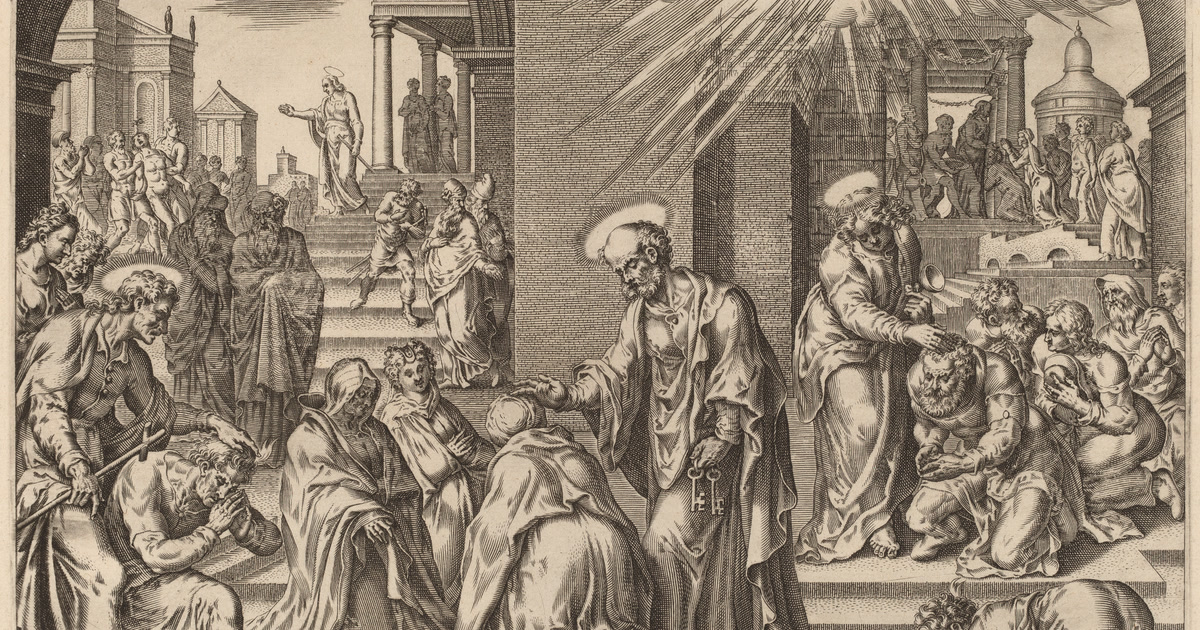
The church in Jerusalem heard about the Samaritans’ conversion and decided to send Peter and John to Samaria (8:14). The expression “received the word of God” indicates that the report they received regarded those conversions as genuine. It is possible that the same report indicated that the Samaritans had not yet received the Holy Spirit and that the church therefore decided to send Peter and John.
Luke does not say why Peter and John went to Samaria, but the fact that the church sent them indicates that this event was crucial to the expansion of the church’s missionary work. The apostles understood that it was important to send a delegation to Samaria.
The next two verses (8:15-16) describe the apostles praying for the Samaritans to receive the Holy Spirit. They prayed because the Spirit had not yet fallen upon any of them (8:16a), for they “had only been baptized in the name of the Lord Jesus” (8:16b). A common question is why there was a delay, an interval between conversion and receiving the Holy Spirit.
Some would argue that the Samaritans did not believe in 8:12 and that they only came to believe after the apostles arrived and prayed for them. This argument, however, is untenable because the text states multiple times that they believed and were baptized. When Peter and John arrived, they prayed specifically for them to receive the Holy Spirit and did not explain the gospel to them again.
Notice the expression “not yet” in 8:16. This may suggest that Luke and his readers expected receiving the Spirit to accompany repentance and salvation naturally. Thus, because of the extraordinary nature of those events, Luke notes that the Spirit had “not yet” fallen upon them before Peter and John laid their hands on them.
Care is needed here because this passage is often used to support the idea that there is a normal stage of the Christian life in which a person has already believed but has not yet received the Spirit. Paul rules out this possibility entirely: “Now if anyone does not have the Spirit of Christ, he is not His” (Romans 8:9). There is no such thing as a believer without the Holy Spirit. What happened here was specific to the transitional period.
The best evidence for this is the pattern of the book of Acts itself. The outpouring of the Spirit follows the exact stages of Acts 1:8, and apostles are present at each new frontier:
- Acts 2—the Jews, in Jerusalem, with the apostles present.
- Acts 8—the Samaritans, with Peter and John sent from Jerusalem.
- Acts 10—the Gentiles, in Cornelius’s house, with Peter present.
- Acts 19—the disciples of John the Baptist, in Ephesus, with Paul present.
Once each group is incorporated, the pattern is not repeated: the rest of the New Testament treats receiving the Spirit as simultaneous with conversion. This is why Acts 8 is often called “the Samaritan Pentecost.” Just as the Spirit was poured out upon the Jewish believers gathered in Jerusalem in Acts 2, here He is poured out upon an entire group of Samaritan believers, and for the same reasons: to mark publicly the inclusion of a new people in the body of Christ. (For a study of the events of Acts 2, see A Study on Pentecost.)
For this reason, I understand Peter and John’s journey to have been necessary both because the church was expanding outward from Jerusalem and because each new stage of Acts 1:8 required apostolic testimony. The presence of Peter and John and the experience of the outpouring of the Holy Spirit served to authenticate the inclusion of the converted Samaritans in the body of Christ.
The text also suggests that there was some perceptible manifestation. Luke says that Simon “saw” that the Spirit was given through the laying on of the apostles’ hands (8:18); there was therefore something observable, not merely an inward conviction. Luke does not specify what it was, but in light of Acts 2, 10, and 19—where speaking in tongues accompanies the outpouring at each new stage—it is quite likely that it was the same sign.
The conversion of the Samaritans is particularly significant for the advance of the gospel because, for the first time, it reached people who were not unequivocally members of the people of Israel. The outpouring of the Holy Spirit upon the Samaritans was also a corporate event; that is, baptism in the Holy Spirit had now been extended to them and, for the first time, to people who were not part of Israel in the strict sense. Therefore, the “delay” of the Holy Spirit was extraordinary and occurred only during the “transitional period.”
“The two stages in the manifestation of the Spirit are part of the scene’s unusual context, in which the church is breaking new ground; therefore, confirmation and affirmation are recorded in a way that does not constitute a paradigm for later practice.” 6
Simon and Peter’s Rebuke (8:18-24)
Luke reported that “even” Simon himself believed and was baptized (8:13a). There is considerable debate over whether Simon truly believed, since he offered money in exchange for the ability to confer the Holy Spirit (8:18-19).
It is not difficult to imagine why he would desire that power, since he claimed to perform miraculous deeds and wanted to be regarded as God.
The question is: does Luke intend to emphasize the power of the gospel even further by recounting the conversion of the man who exerted a negative influence over the Samaritans, or does he intend to highlight that Simon was interested only in the apostles’ power in order to contrast him with Philip’s preaching? The answer to this question will depend on how Peter’s rebuke and Simon’s response are interpreted.
Those who maintain that Simon did indeed believe argue that Luke says he believed and was baptized; if Luke wanted to portray him as someone who did not believe, why would he describe his faith and baptism with the same verbs used for the Samaritans? Second, since Acts 2, the practice of the church in Jerusalem had been to baptize those who accepted the message concerning repentance and the need for faith in Jesus. Philip therefore did not consider Simon’s faith illegitimate. Otherwise, he would not have baptized him.
The argument is serious, but the answer is found in Luke himself. In the parable of the soils, Luke records people who “believe for a while and in time of temptation fall away” (Luke 8:13)—using the exact same verb. For Luke, then, saying that someone “believed” does not by itself settle the question of saving faith.
Acts 8:20-23 — “But Peter said to him, ‘Your money perish with you, because you thought that the gift of God could be purchased with money! You have neither part nor share in this ministry, for your heart is not right before God. Repent therefore of this wickedness of yours, and pray to the Lord that, if possible, the intent of your heart may be forgiven you. For I see that you are poisoned by bitterness and bound by iniquity.’”
Each statement is harsher than the one before it:
- “Your money perish with you” (8:20). The word translated “perish” is the term the New Testament uses for eternal destruction. Peter is not merely saying that Simon’s money was misused but is linking the fate of the money to the fate of the man.
- “You have neither part nor share in this ministry” (8:21a). The expression echoes Old Testament language about having no inheritance among the people of God (Deuteronomy 12:12; 14:27). Simon is on the outside.
- “Your heart is not right before God” (8:21b). Peter points to Simon’s heart and makes clear that he does not see a regenerated heart.
Simon’s response points even more strongly to his false conversion. Peter commands him, “Repent … and pray to the Lord” (8:22). Simon does neither. Instead of repenting and crying out to God himself, he replies, “Pray to the Lord for me, that none of the things which you have spoken may come upon me” (8:24). He does not seek forgiveness; he seeks only to escape the consequences, and even then only by proxy. As Pastor David Melin points out, this is the behavior of someone who fears punishment, not someone who hates his own sin. 7
For these reasons, I understand that Simon did not experience a genuine conversion and that his religious practice was in fact driven by ulterior motives.
The reason Luke devotes a substantial passage to Simon is that a very clear contrast emerges here:
- Philip pointed to God, while Simon pointed to himself.
- Both impressed the crowd: Simon through charlatanism and very likely under the influence of demonic power; Philip through signs and wonders performed by divine power. Simon deceived; Philip proclaimed the truth of the gospel.
- The people were amazed by Simon’s magic, but they were saved only through the power of the Holy Spirit.
This is the power of the gospel: the power of the good news about Jesus and the kingdom of God. God’s grace saved the Samaritans, while Simon’s “greatness” would have led them directly to eternal condemnation.
Applications
The Gospel Crosses Hostilities We Consider Insurmountable
The first community to receive the gospel outside Jerusalem was precisely the one the Jews despised most.
And notice who was sent to lay hands on them. John is the same disciple who, only a few years earlier, when a Samaritan village refused to receive Jesus, asked, “Lord, do You want us to command fire to come down from heaven and consume them?” (Luke 9:54). The man who had wanted to see Samaria burned now prays for Samaria to receive the Holy Spirit. The gospel transformed not only the Samaritans; it also transformed the apostle who had hated them.
The gospel shows no partiality toward people, groups, or nations.
God Can Use Even Opposition to Expand His Work
The great persecution that arose against the church after Stephen’s death was undoubtedly a real evil: Saul was ravaging the church, entering house after house and dragging men and women off to prison. No one there was praying for that to happen. And yet it was precisely this forced scattering that took Philip to Samaria and resulted in the gospel’s first expansion beyond Israel’s ethnic boundaries.
This does not mean that persecution is good in itself or that we should seek suffering. It means that God’s sovereignty operates even through what men intend for evil. What Saul intended as a weapon to destroy the church, God used as the very means of spreading it.
Not All Spiritual Power Comes from God
Simon fascinated the Samaritans for years with his magic, to the point that he was called “the Great Power of God.” The people were amazed. The contrast between Simon and Philip is more than a historical curiosity: Satan is at work in this world to deceive people, and he uses people like Simon.
The passage, however, does not leave us with only a warning; it gives us the criterion as well. The difference between Philip and Simon was not how much amazement they produced, since both produced amazement. It was whom they pointed to. Philip preached “the kingdom of God and the name of Jesus Christ” (8:12); Simon claimed that he himself was “someone great” (8:9). Power that impresses is not necessarily divine power. The question to ask in the face of any spiritual manifestation is not “Is this impressive?” but “Who is being proclaimed here?”
It is also worth noting that the gospel delivered the Samaritans not only from Simon’s magic but also from a mistaken messianic expectation. They expected the Taheb and received Christ, the true Messiah. God delivers both from explicit occultism and from sincerely mistaken theology.
Not All Professions of Faith Are True Conversions
As Simon’s story illustrates, not all professions of faith are genuine conversions. People may profess faith and even be baptized, yet their faith may still not be authentic.
This should produce two responses in us, not just one. The first is self-examination: Do our lives demonstrate true conversion? The second concerns the reality of people who profess faith in the church but do not possess true faith: if even Philip did not distinguish the false from the true, we should not be surprised when this happens among us, nor should we conclude that the gospel has failed.
Footnotes
-
Eckhard J. Schnabel, Acts, Expanded Digital Edition, Zondervan Exegetical Commentary on the New Testament (Grand Rapids, MI: Zondervan, 2012), 399. ↩
-
The Greek text says “[the] city of Samaria,” and the manuscripts differ as to whether the definite article appears before “city.” Even where the article appears, the expression may simply mean “the principal city of the district.” In either reading, “of Samaria” identifies the city by the region to which it belongs. ↩
-
Darrell L. Bock, Acts, Baker Exegetical Commentary on the New Testament (Grand Rapids, MI: Baker Academic, 2007), 324. ↩
-
Definition according to the lexicon of Bauer, Danker, Arndt, and Gingrich (BDAG), s.v. μαγεύω. ↩
-
Some caution is appropriate when using Justin. Many scholars believe that in First Apology 26 he misunderstood a Roman inscription dedicated to the Sabine deity Semo Sancus, reading it as a tribute to Simon. This does not invalidate his testimony about the existence of a Samaritan cult centered on Simon, but it cautions against placing too much weight on the details. ↩
-
Bock, Acts, 330. ↩
-
From his lecture notes, “QUESTION: Was Simon a believer?”, p. 37. ↩